Sunday, 4 September 2016

A strange thing happened in the stratosphere: A 60-year pattern in the stratosphere changes up

Credit : NASA
This disruption to the wind pattern -- called the "quasi-biennial oscillation" -- did not have any immediate impact on weather or climate as we experience it on Earth's surface. But it does raise interesting questions for the NASA scientists who observed it: If a pattern holds for six decades and then suddenly changes, what caused that to happen? Will it happen again? What effects might it have?
"The quasi-biennial oscillation is the stratosphere's Old Faithful," said Paul Newman, Chief Scientist for Earth Sciences at NASA's Goddard Space Flight Center, Greenbelt, Maryland, and lead author on a new paper about the event published online in Geophysical Research Letters. "If Old Faithful stopped for a day, you'd begin to wonder about what was happening under the ground."
Winds in the tropical stratosphere, an atmospheric layer that extends from about 10 to 30 miles above Earth's surface, circulate the planet in alternating easterly and westerly directions over roughly a two-year period. Westerly winds develop at the top of the stratosphere, and gradually descend to the bottom, about 10 miles above the surface while at the same time being replaced by a layer of easterly winds above them. In turn, the easterlies descend and are replaced by westerlies.
This pattern repeats every 28 months. In the 1960s scientists coined it the "quasi-biennial oscillation." The record of these measurements, made by weather balloons released in the tropics at various points around the globe, dates to 1953.
The pattern never changed -- until late 2015. As the year came to a close, winds from the west neared the end of their typical descent. The regular pattern held that weaker easterly winds would soon replace them. But then the westerlies appeared to move upwards and block the downward movement of the easterlies. This new pattern held for nearly half a year, and by July 2016 the old regime seemed to resume.
"It's really interesting when nature throws us a curveball," Newman said.
The quasi-biennial oscillation has a wide influence on stratospheric conditions. The amount of ozone at the equator changes by 10 percent between the peaks of the easterly and westerly phases, while the oscillation also has an impact on levels of polar ozone depletion.
With this disruption now documented, Newman and colleagues are currently focused on studying both its causes and potential implications. They have two hypotheses for what could have triggered it -- the particularly strong El Niño in 2015-16 or the long-term trend of rising global temperatures. Newman said the scientists are conducting further research now to figure out if the event was a "black swan," a once-in-a-generation event, or a "canary in the coal mine," a shift with unforeseen circumstances, caused by climate change.
Story Source:
The above post is reprinted from materials provided by NASA/Goddard Space Flight Center. The original item was written by Patrick Lynch. Note: Content may be edited for style and length.

How did the universe begin? Hot Big Bang or slow thaw?

Did the universe begin with a hot Big Bang or did it slowly thaw from an extremely cold and almost static state? Prof. Dr. Christof Wetterich, a physicist at Heidelberg University, has developed a theoretical model that complements the nearly 100-year-old conventional model of cosmic expansion. According to Wetterich's theory, the Big Bang did not occur 13.8 billion years ago -- instead, the birth of the universe stretches into the infinite past. This view holds that the masses of all particles constantly increase. The scientist explains that instead of expanding, the universe is shrinking over extended periods of time.
Cosmologists usually call the birth of the universe the Big Bang. The closer we approach the Big Bang in time, the stronger the geometry of space and time curves. Physicists call this a singularity -- a term describing conditions whose physical laws are not defined. In the Big Bang scenario, the spacetime curvature becomes infinitely large. Shortly after the Big Bang, the universe was extremely hot and dense. Prof. Wetterich believes, however, that a different "picture" is also possible. If the masses of all elementary particles grow heavier over time and gravitational force weakens, the universe could have also had a very cold, slow start. In that view, the universe always existed and its earliest state was virtually static, with the Big Bang stretching over an infinitely long time in the past. The scientist from the Institute for Theoretical Physics assumes that the earliest "events" that are indirectly observable today came to pass 50 trillion years ago, and not in the billionth of a billionth of a billionth of a second after the Big Bang. "There is no longer a singularity in this new picture of the cosmos," says Prof. Wetterich.
His theoretical model explains dark energy and the early "inflationary universe" with a single scalar field that changes with time, with all masses increasing with the value of this field. "It's reminiscent of the Higgs boson recently discovered in Geneva. This elementary particle confirmed the physicists' assumption that particle masses do indeed depend on field values and are therefore variable," explains the Heidelberg scientist. In Wetterich's approach, all masses are proportional to the value of the so-called cosmon field, which increases in the course of cosmological evolution. "The natural conclusion of this model is a picture of a universe that evolved very slowly from an extremely cold state, shrinking over extended periods of time instead of expanding," explains Prof. Wetterich.
Wetterich stresses that this in no way renders the previous view of the Big Bang "invalid," however. "Physicists are accustomed to describing observed phenomena using different pictures." Light, for example, can be depicted as particles and as a wave. Similarly, his model can be seen as a picture equivalent to the Big Bang. "This is very useful for many practical predictions on the consequences that arise from this new theoretical approach. However, describing the 'birth' of the universe without a singularity does offer a number of advantages," emphasises Prof. Wetterich. "And in the new model, the nagging dilemma of 'there must have been something before the Big Bang' is no longer an issue."
Story Source:
The above post is reprinted from materials provided by Heidelberg University. Note: Content may be edited for style and length.

9 Foods That Have Been Renamed To Get You To Buy Them

What’s in a name? A lot, apparently. Especially when we’re talking about food. Don’t believe us? Would you pick Patagonian Toothfish over Chilean Sea Bass? Would you ever tuck into a lunch of locusts? How would you feel about Sky Prawn Sandwich? Would you pay more ‘jam’, or ‘fruit preserve’?
The fact is that the name of a food – that is, the way it’s described – plays a huge part in how much we want to eat it, and what we’re willing to pay for it. It makes sense that food producers, manufacturers, and marketers would take advantage of this, and ensure they name foods to make them sound as appetising – and premium – as possible.
The infographic below details nine foods that were renamed to make them more appealing to consumers – whether that’s to boost sales and command a higher price or shake off a poor reputation.


Click to enlarge


Saturday, 3 September 2016

100 Funny and Random Facts


  1.  Banging your head against a wall burns 150 calories an hour.
  2. In the UK, it is illegal to eat mince pies on Christmas Day!
  3. Pteronophobia is the fear of being tickled by feathers!
  4. When hippos are upset, their sweat turns red.
  5. A flock of crows is known as a murder.
  6. “Facebook Addiction Disorder” is a mental disorder identified by Psychologists.
  7. The average woman uses her height in lipstick every 5 years.
  8. 29th May is officially “Put a Pillow on Your Fridge Day“.
  9. Cherophobia is the fear of fun.
  10. Human saliva has a boiling point three times that of regular water.
  11. If you lift a kangaroo’s tail off the ground it can’t hop.
  12. Hyphephilia are people who get aroused by touching fabrics.
  13. Billy goats urinate on their own heads to smell more attractive to females.
  14. The person who invented the Frisbee was cremated and made into frisbees after he died!
  15. During your lifetime, you will produce enough saliva to fill two swimming pools.
  16. If Pinokio says “My Noes Will Grow Now”, it would cause a paradox.
  17. Polar bears can eat as many as 86 penguins in a single sitting. (If they lived in the same place)
  18. King Henry VIII slept with a gigantic axe beside him.
  19. Bikinis and tampons invented by men.
  20. An eagle can kill a young deer and fly away with it.
  21. Heart attacks are more likely to happen on a Monday.
  22. If you consistently fart for 6 years & 9 months, enough gas is produced to create the energy of an atomic bomb!
  23. An average person’s yearly fast food intake will contain 12 pubic hairs.
  24. The top six foods that make your fart are beans, corn, bell peppers, cauliflower, cabbage and milk!
  25. There is a species of spider called the Hobo Spider.
  26. ‘Penis Fencing’ is a scientific term for the mating ritual between flatworms. It involves two flatworms attempting to stab the other flatworm with their penis.
  27. A toaster uses almost half as much energy as a full-sized oven.
  28. A baby spider is called a spiderling.
  29. You cannot snore and dream at the same time.
  30. The following can be read forward and backwards: Do geese see God?
  31. A baby octopus is about the size of a flea when it is born.
  32. A sheep, a duck and a rooster were the first passengers in a hot air balloon.
  33. In Uganda, 50% of the population is under 15 years of age.
  34. Hitler’s mother considered abortion but the doctor persuaded her to keep the baby.
  35. Arab women can initiate a divorce if their husbands don’t pour coffee for them.
  36. Recycling one glass jar saves enough energy to watch TV for 3 hours.
  37. Smearing a small amount of dog feces on an insect bite will relieve the itching and swelling.
  38. Catfish are the only animals that naturally have an odd number of whiskers.
  39. Facebook, Skype and Twitter are all banned in China.
  40. 95% of people text things they could never say in person.
  41. The Titanic was the first ship to use the SOS signal.
  42. In Poole, ‘Pound World’ went out of business because of a store across the road called ’99p Stores’, which was selling the same products but for just 1 pence cheaper!
  43. About 8,000 Americans are injured by musical instruments each year.
  44. The French language has seventeen different words for ‘surrender’.
  45. Nearly three percent of the ice in Antarctic glaciers is penguin urine.
  46. Bob Dylan’s real name is Robert Zimmerman.
  47. A crocodile can’t poke its tongue out :p
  48. Sea otters hold hands when they sleep so they don’t drift away from each other.
  49. A small child could swim through the veins of a blue whale.
  50. Bin Laden’s death was announced on 1st May 2011. Hitler’s death was announced on 1st May 1945.
  51. J.K. Rowling chose the unusual name ‘Hermione’ so young girls wouldn’t be teased for being nerdy!
  52. Hewlett-Packard’s name was decided in a coin toss.
  53. The total number of steps in the Eiffel Tower are 1665.
  54. The Pokémon Hitmonlee and Hitmonchan are based off of Bruce Lee and Jackie Chan.
  55. The toothpaste ‘Colgate’ in Spanish translates to ‘go hang yourself’
  56. Pirates wore earrings because they believed it improved their eyesight.
  57. Los Angeles’s full name is “El Pueblo de Nuestra Senora la Reina de los Angeles de Porciuncula.”
  58. Dr. Kellogg introduced Kellogg Corn Flakes in hopes that it would reduce masturbation.
  59. The testicles on an octopus are located in its head!
  60. In England, in the 1880’s, “Pants” was considered a dirty word.
  61. It snowed in the Sahara desert for 30 minutes on the 18th February 1979.
  62. Every human spent about half an hour as a single cell.
  63. If you leave everything to the last minute… it will only take a minute.
  64. Ithyphallophobia is the fear of erections.
  65. The first alarm clock could only ring at 4am.
  66. Birds don’t urinate.
  67. Dying is illegal in the Houses of Parliaments – This has been voted as the most ridiculous law by the British citizens.
  68. The word ‘ejaculation’ comes from the Latin word meaning ‘throwing out’.
  69. The 20th of March is known as Snowman Burning Day!
  70. Slugs have 4 noses.
  71.  Panphobia is the fear of everything… which is a pretty unlucky phobia to have.
  72. An apple, potato, and onion all taste the same if you eat them with your nose plugged.
  73. George Washington grew marijuana in his garden.
  74. A company in Taiwan makes dinnerware out of wheat, so you can eat your plate!
  75. The average person walks the equivalent of twice around the world in a lifetime.
  76. The Bible is the most shoplifted book in the world.
  77. Marco Hort has the world record for fitting 264 straws in his mouth at once!
  78. Mel Blanc – the voice of Bugs Bunny – was allergic to carrots.
  79. California has issued 6 drivers licenses to people named Jesus Christ.
  80. According to Genesis 1:20-22 the chicken came before the egg.
  81. In the Caribbean there are oysters that can climb trees.
  82. Worms eat their own poo.
  83. Squirrels forget where they hide about half of their nuts.
  84. Over 1000 birds a year die from smashing into windows.
  85. The inventor of the Waffle Iron did not like waffles.
  86. George W. Bush was once a cheerleader.
  87. In Japan, it is completely acceptable to name your child ‘Buttocks’ or ‘Prostitute’.
  88. In 1895 Hampshire police handed out the first ever speeding ticket, fining a man for doing 6mph!
  89. Each year, there are more than 40,000 toilet related injuries in the United States.
  90. A tapir has the largest penis-to-body ratio of any animal.
  91. Mewtwo is a clone of the Pokémon Mew, yet it comes before Mew in the Pokédex.
  92. Every year more than 2500 left-handed people are killed from using right-handed products.
  93. Madonna suffers from garophobia which is the fear of thunder.
  94. China has more English speakers than the United States.
  95. Samuel L. Jackson requested to have a purple light saber in Star Wars in order for him to accept the part as Mace Windu.
  96. Paraskavedekatriaphobia is the fear of Friday the 13th!
  97. Kleenex tissues were originally used as filters in gas masks.
  98. In 1998, Sony accidentally sold 700,000 camcorders that had the technology to see through people’s clothes. These cameras had special lenses that use infrared light, which allowed you to see through some types of clothing.
  99. Upon losing battles, apes will tend to masturbate.
  100. Ronald McDonald is “Donald McDonald” in Japan because it makes pronunciation easier for the Japanese. In Singapore he’s known as “Uncle McDonald”.

Sony Promises Robots With Emotions During IFA Fair


The Sony CEO and President, Kazuo Hirai announced during a press conference which was held at the IFA international consumer electronics trade show in Berlin, that the company Sony is designing a robot which will be “capable of forming an emotional connection” with humans.
As we all know very well that Sony Corporation is a Japanese multinational conglomerate corporation headquartered in Kōnan, Minato, Tokyo, Japan. Its diversified business includes consumer and professional electronics, gaming, entertainment and financial services.
The tech giant Sony recently promised a new robot which will have capabilities of forming an emotional connection with the human beings. Yes, sounds pretty interesting. Currently, the robot is in under development phase and users will have to wait a little longer for it, the company’s CEO, Kazuo Hirai said.
Sony already began its work on a residential robot in April this year 2016 and revealed the existence of the first project in the month of June. Since then, Sony has been silent about what they are doing exactly.
The Sony CEO and President Kazuo Hirai first indicated that the company could be about to reveal the robot, speaking during a press conference on technology fair IFA 2016 in Berlin.
But wait, just little Later he said that “Actually, I have an update on this,”. But the CEO, Kazuo Hirai quickly ended the hopes of the public just by saying that the “update is that the robot will not be at IFA 2016”.
“I am happy to report that we are working hard to create a robot for your home that not only able to help you in the day-to-day life, but really can establish an emotional connection with you all,” said the CEO, Kazuo Hirai.
The robot will benefit from Sony’s engineering skills in audio and video technologies, sensors, mechatronics, artificial intelligence (AI) and communications, he said. Also added that “You will definitely want to stay connected with it”.
This robot will be the first for Sony since the company discontinued its robots division during a previous restructuring. The Japanese company Sony was the first to enter the residential robot market with its Aibo robot dogs which were started in the early 2000s.

 Tushar Subhra Dutta- TechViral.com

Using Java 8 Lambda expressions in Android


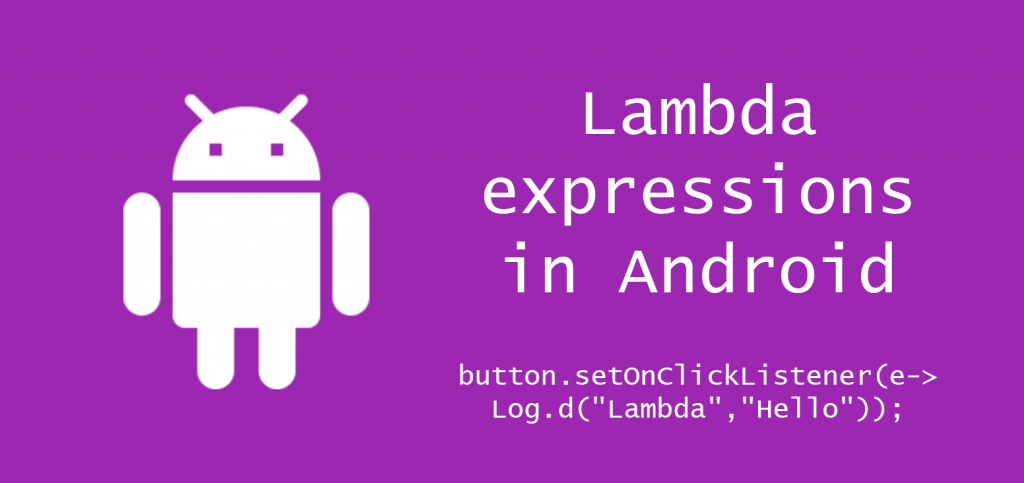
Lambda expressions are one of the most important features added to Java 8. Lambda expressions simplifies programming. Currently there is no direct way to use Lambda expressions in Android. So we need to use Gradle Retrolambda plugin in order to use Lambda expressions. In this tutorial we are going to do that.

Create a new project in Android Studio with package name of your choice.

Adding Dependencies in build.gradle

We need to modify both the build.gradle files. Open the Project’s build.gradle file (outer build.gradle).
Add the following dependency for the Gradle Retrolambda plugin.
classpath 'me.tatarka:gradle-retrolambda:3.2.5'
The complete build.gradle is given as,
// Top-level build file where you can add configuration options common to all sub-projects/modules.
buildscript {
    repositories {
        jcenter()
    }
    dependencies {
        classpath 'com.android.tools.build:gradle:2.0.0-beta5'
        classpath 'me.tatarka:gradle-retrolambda:3.2.5'
        // NOTE: Do not place your application dependencies here; they belong
        // in the individual module build.gradle files
    }
}
allprojects {
    repositories {
        jcenter()
    }
}
task clean(type: Delete) {
    delete rootProject.buildDir
}
The next is to modify the App’s build.gradle file (inner build.gradle). The me.tatarka.retrolambda plugin should be applied.
A new compileOptions block should be added then sourceCompatibility and targetCompatibility Java version should be set as 1.8.
compileOptions {
    sourceCompatibility JavaVersion.VERSION_1_8
    targetCompatibility JavaVersion.VERSION_1_8
}
The Java 8 JDK path should be set in retrolambda block.
retrolambda {
    jdk '/usr/lib/jvm/java-8-openjdk-amd64'
}
Here /usr/lib/jvm/java-8-openjdk-amd64 is my Java JDK path. Replace with your own.The complete build.gradle is given as,
apply plugin: 'com.android.application'
apply plugin: 'me.tatarka.retrolambda'
android {
    compileSdkVersion 23
    buildToolsVersion "23.0.2"
    defaultConfig {
        applicationId "com.learn2crack.androidlambda"
        minSdkVersion 21
        targetSdkVersion 23
        versionCode 1
        versionName "1.0"
    }
    buildTypes {
        release {
            minifyEnabled false
            proguardFiles getDefaultProguardFile('proguard-android.txt'), 'proguard-rules.pro'
        }
    }
    compileOptions {
        sourceCompatibility JavaVersion.VERSION_1_8
        targetCompatibility JavaVersion.VERSION_1_8
    }
    retrolambda {
        jdk '/usr/lib/jvm/java-8-openjdk-amd64'
    }
}
dependencies {
    compile fileTree(dir: 'libs', include: ['*.jar'])
    testCompile 'junit:junit:4.12'
    compile 'com.android.support:appcompat-v7:23.1.1'
}
Now again sync the project. Now all set. You can use lambda expressions in your project.
Here I am using OnClickListener with Button. The code is as simple as,
Button button = (Button) findViewById(R.id.btn);
button.setOnClickListener(e-> Log.d("Lambda","Hello"));

Note: Now Google is in the process of shifting from Apache Harmony Java implementation to OpenJDK implementation. So these features will be supported in future verions of Android, Mostly Android N.

Source: learn2crack.com

Threat of group extinction proves a powerful motivator

Charles Darwin was right: Groups enjoy an advantage whose members are "ready to aid one another and to sacrifice themselves for the common good," according to a new study by researchers at Rice University, Texas A&M University and the University of East Anglia.
Using variations of the public goods game, the researchers showed that when no other mechanism is present to reinforce group cooperation, the threat of group extinction is sufficiently powerful to motivate and increase cooperation within a group.
"The finding is stunning for what it says about group extinction," said Rice Professor Rick Wilson, one of the authors of the paper appeared this week in the journal PLOS ONE. "People respond to threats to their group. They're willing to forego opportunities to free ride on the efforts of their group members."
The article, "Group-Level Selection Increases Cooperation in the Public Goods Game," provides insight into the origins of group conflict and "supports the notion that competition between groups is part of what has cultivated human cooperation," the authors said.
"History seems to support the idea that a group working together can overcome another group and drive them to extinction," said Wilson, the Herbert S. Autrey Professor of Political Science, professor of statistics and of psychology at Rice. "But it had not been clear whether this was due to groups cooperating when in competition or to pressure of extinction through selection."
The researchers conducted a controlled laboratory experiment to determine whether competition or extinction drives increased cooperation within groups. The experiment was based on the public goods game in which participants in groups are each given a set amount of money. Each group member secretly chooses how much to put into the group account and how much to retain for their own account. The amount in the group account is multiplied by a set factor, and the payoff is equally divided among the members of the group; participants also keep the money they did not contribute to the group account.
In the researchers' experiment, 168 undergraduate students were randomly assigned to groups of four. No participant knew who their fellow group members were, and all interactions were conducted anonymously over a computer network.
The game consisted of two blocks of 10 periods. Each period every subject was given 50 monetary units and decided how much to keep in their private account and how much to put in the group account. The private account paid one to one. The contributions to the group account were doubled by the experimenters, and the total of the group account was divided equally among each member of the group.
"This basic experimental design has been used hundreds of times, and free riding is common," he said. "We wanted to know whether competition or extinction works to eliminate free riding in the way that Darwin suggests."
The researchers used four treatments in their experiment:
The first treatment replicated the standard public goods game. At the end of each period, subjects found out how much was contributed by others in their group to the group account. They were told nothing about the contributions of participants in the other groups.
Group competition was introduced in the second treatment. Subjects saw the same information as in the first treatment; however, they were told that at the end of the first 10 periods their group would be ranked in terms of total earnings against the other groups in the experiment.
In the third treatment, extinction was introduced. Subjects were told that at the end of 10 periods their earnings would be compared with all other subjects' earnings. One-third of the lowest earners would be removed from the experiment and not allowed to participate in the second block of 10 periods.
In the fourth treatment, extinction was applied to groups rather than individuals. Subjects were told that at the end of the first 10 periods their group's earnings would be compared with the other groups' earnings. Groups that fell in the bottom one-third of earners would be removed from the experiment and would not participate in the second block of 10 periods.
The researchers found that in treatments one through three, average contributions declined steadily over the first 10 periods. "Over time, people contribute less to the public good and favor their private investments," Wilson said.
"But when we introduce group extinction, we see a remarkably different result," he said. "At the outset, individuals contribute almost everything to the group account. The pressure of group extinction results in individuals cooperating within the group."
Researchers found that group extinction, the fourth treatment, led to greater contributions to the group account (92 percent of the endowment, on average) than any other treatment (35 percent in first treatment, 36 percent in third treatment, or individual extinction, and 42 percent in the second treatment, group comparison).
The authors noted that "group extinction leads to enhanced cooperation as long as the selection mechanism is present. Once it is removed, contributions remain higher for a time, but fall quickly toward ... zero contributions. The culture of cooperation engendered by the group extinction mechanism has only a brief longer-term carryover after the mechanism is removed."